Am vs Am7 on Guitar: One Finger, One New Note
You can play Am, but Am7 makes you pause. With standard tuning and no capo, try lifting just the ring finger from your Am shape. Fewer fingers can still give you more different notes. This lesson compares two open shapes slowly, using the diagram and your ears rather than a fast chord-change target.
主要功能与选项
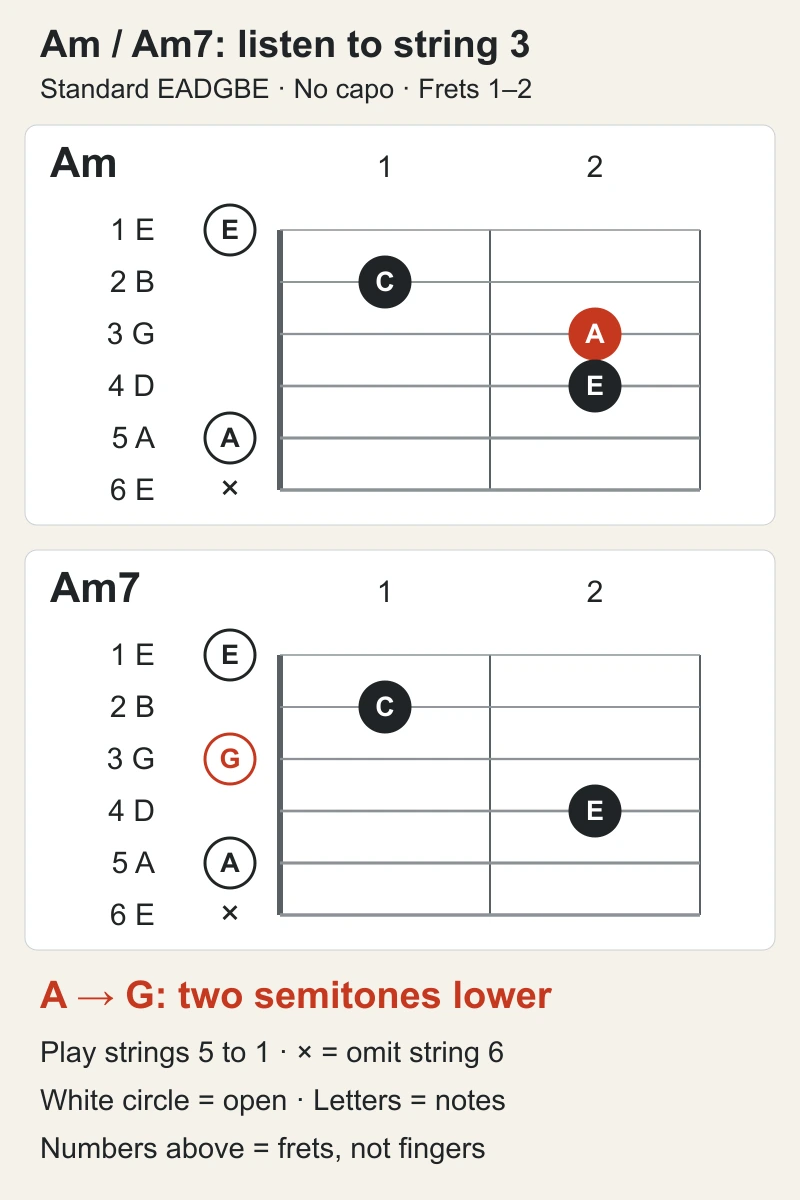
- Am is x02210 and this Am7 is x02010, from string 6 to 1. x means omit; 0 means open
- Lift the ring finger from string 3, fret 2: A becomes open G, a whole step lower
- Play strings 5 to 1 in both shapes. Keep the open third string clear in Am7
1. Lift one finger, then pick again
For Am, put your index on string 2, fret 1; middle on string 4, fret 2; and ring on string 3, fret 2. Strings 5 and 1 stay open. Lift the ring finger clear of string 3, keeping the other two fingers in place, for this Am7 shape. Pick strings 5 to 1 again slowly. The diagram puts thin string 1 at the top and thick string 6 at the bottom. Letters inside circles are note names; numbers above the grid are frets, not fingers. The written shapes x02210 and x02010 run from string 6 to 1, not from the diagram's top down.
2. Fewer fingers can introduce another note
Am contains A, C and E; Am7 contains A, C, E and G. Here, string 3 changes from A to G, while open string 5 keeps A. You therefore retain the root and introduce G as another chord tone. Moving from fret 2 to the open string lowers that note by two semitones: one whole step. The m means minor, and the 7 indicates a minor seventh, not fret 7. Repeated note names mean five sounding strings give three note classes in Am and four in Am7. Descriptions of the mood vary with the listener and musical setting; first compare just the changed third string.
3. Check the open G and the low A
If Am7's third string is muted, check the lifted ring finger and the side of the middle finger on string 4. Pick string 3 alone and adjust contact before adding pressure. Rest if your hand or wrist hurts. Start the strum on string 5 and avoid string 6. Its open E is a chord tone, but adding that lower E changes the bass from the A used here. Am and Am7 are different chords, so this is not an instruction to replace every Am in a song. Pick again after lifting the finger: making the change sound with a pull-off alone is a separate exercise.
Pio: If the name gains a 7, why do I use fewer fingers?
Dock-sensei: Finger count and different notes are separate things. Lifting the ring finger gives G on string 3 while string 5 keeps A. Pick the third string again and listen for the change.
An eight-minute session
- 2 minutes: place Am and pick strings 5 to 1 individually, leaving string 6 out. Check the shape, then release your hand and rest
- 2 minutes: lift only the ring finger for Am7. Pick string 3 alone to hear open G. If it is muted, check finger contact rather than squeezing harder
- 2 minutes: pick Am once, then Am7 once. Listen for A changing to G on string 3 and check that the open A on string 5 stays the same. Compare clean sounds without a speed target
- 2 minutes: if comfortable, manually set 60 BPM and 4/4. In bar 1, play Am on beat 1, hold through beat 2, then stop on beat 3 and rest on beats 3 and 4. Play Am7 the same way in bar 2. Rest for all of bar 3. Remove the click if needed and relax your hand before trying again
Review and references
Last content review:
Manufacturer, music-teaching and university sources informed checks of shapes and chord tones, with pitches calculated from standard tuning. Both languages were reviewed twice for the whole-step A-to-G change, retained root, sixth-string bass and finger count versus note classes. The diagram and eight-minute routine with rests are original editorial suggestions.
- Learn How to Play A Minor on Guitar — Fender
- Am7 Chord: A Minor 7 — Bell & Co Music
- Introduction to Seventh Chords — University of Puget Sound / Robert Hutchinson
References support the editorial review. They do not provide an individual diagnosis or guarantee compatibility with every instrument or model.
常见问题
Is a two-finger Am7 correct?
Yes. Index on string 2, fret 1, middle on string 4, fret 2, and open strings 5, 3 and 1 give x02010. Omit string 6. Other Am7 voicings exist; this lesson focuses on that open shape.
Is the change from Am to Am7 a semitone?
Here, string 3 moves from A at fret 2 to open G: two semitones, or one whole step, lower. You are not lowering the entire chord. The other four sounding strings stay unchanged.
Are Am7 and A7 the same?
No. Am7 contains A, C, E and G, while A7 contains A, C♯, E and G. The m changes the third, so check the symbol written in your music.
Should I press harder if Am7's third string is silent?
It is an open string, so check for contact from other fingers first. If it also fails to ring with all fingers removed, the shape may not be the cause. Ask a teacher or guitar shop rather than forcing your hand.
Is sounding string 6 always a wrong note?
Open E belongs to both chords, but it changes the lowest note. Start from string 5 for the A-bass shapes compared here. An intentional E bass in a song is a different choice.
Will the metronome identify my chords?
This exercise does not grade your playing. Manually set 60 BPM and 4/4, and check the frets and sounds yourself. Eight minutes, including rests, is an editorial practice suggestion, not a mastery deadline.